INTRODUCTION
Globally, it is estimated to produce 3.5 billion tons of waste yearly by 2050 which is a startling number that validates the scope of our global waste scenario. Nevertheless, less than one-third of this waste is treated through proper waste management techniques which involves diverse approaches like biological, chemical etc. The remainder ends up sinking ecosystems, polluting waterways, flooding landfills and worsening climate change. The increased waste load in cities and towns has augmented rapid urbanization, shifting lifestyles and a reliance on single-use plastics. Municipal systems are exhausted, landfills are at dangerously overstretched levels and marginalized groups are suffering the most from the effects on environment and human health. Conventional approaches that were solely dealing with collection and disposal are not working adequately. A paradigm change is essential from transitioning beyond the linear economy to circular economy that continually reuse, recycle or compost waste rather than disposing it. This is when Zero Waste to Landfill (ZWL) becomes imperative which is about establishing processes that either very little or optimally nothing, ends up in the landfill.
NTPC has an Integrated Plastic Management Policy 2019 that acts as a direction to implement plastic waste management methods in order to address issues related to Plastic waste management. NTPC has also developed zero deviation document 2018 in order to implement an effective waste management guideline that meets all legislative and regulatory requirements. Lara Super Thermal Power station, a division of NTPC Ltd. that is located at Raigarh, Chhattisgarh is a great example of how industrial process may cohabit peacefully with the environment by ensuring proper waste management. This articles outlines the NTPC Lara initiatives which serve as a sustainable model for other industries and show the dedication in achieving Zero Waste to Landfill.
CASE STUDY: NTPC initiatives towards Zero Waste to Landfill
Over the past years, Maitree Nagar Township of NTPC Lara has been functioning to position the vision of Zero Waste to Landfill into action. Expansion of ZWL concepts in collaboration with residents, local market, shopping complex etc., have proven that transformation is not only possible but also replicable when people enthusiastically contribute. Several environmental awareness sessions to educate the residents have been conducted in order to encourage them to take up source segregation of waste. The initiatives emphasizing different approaches that have been executed at Maitree Nagar Township are:
-Establishment of all required waste management facilities and disposal as per Zero Deviation Document
-Door to Door Campaign for creating awareness among residents
-Ban on Single Use Plastic within the township
-Collection of domestic waste by E-vehicles to promote sustainability
-Conversion of biodegradable waste into compost to use for horticulture purposes
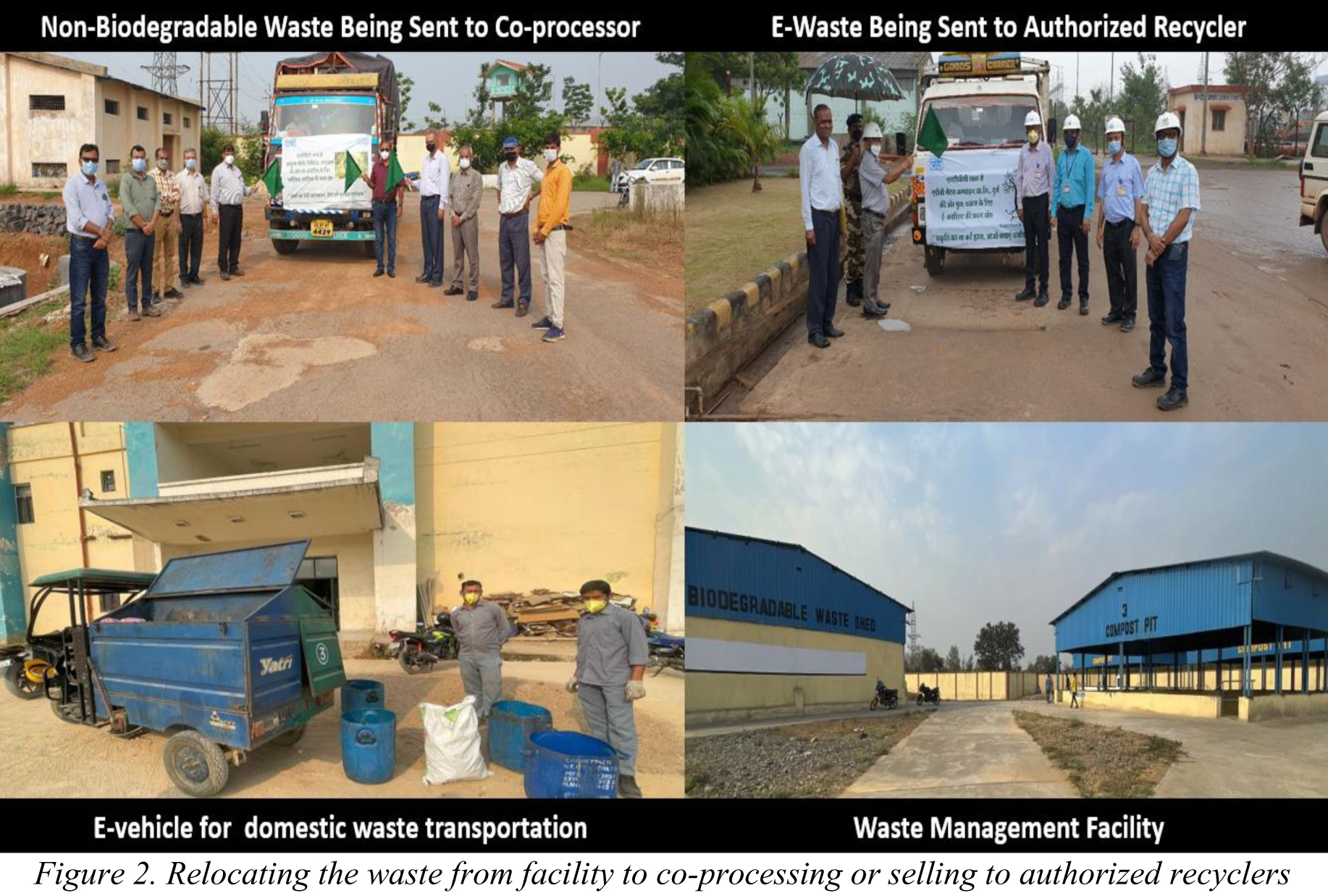
-Relocating non-biodegradable waste to co-processing or selling to authorized recyclers.
These initiatives reflect that ZWL is not just a dream; but it is a practicable possibility that townships can attain today. NTPC Lara township has a population of roughly 2150 with total number of households of 666 along with 13 non-residential premises. It not only indicates the relatively small but also an organized township with all types of waste management facilities established within. The per capita generation of waste is approximately 250 grams per day which accounts for estimated total waste generation of 0.535 Tonnes per day reflecting 100% waste collection efficiency. Among the total waste generated, over 0.4 Tpd of waste has been processed in-house and other 0.135 Tpd of waste is temporarily stored at waste management facility which is further sent for co-processing.
The journey started with source segregation as the first step, assuring that each segregated waste had a specific defined treatment or recovery option. About 90% of residential premises segregates waste at source and non-residential areas within township follows 100% proper waste storage practices. Clearly, there is no incidence of open dumping which highlights the effective awareness created among the residents. Door to Door collection system is fully implemented covering entire township area through E-vehicle supporting sustainable mobility by reducing carbon emissions. Upon segregation, to store and treat the biodegradable and non-biodegradable waste categories, a waste management facility is established very close to the township near the main gate. The land available for processing of waste is 0.54 hectares whereas 0.225 hectares is currently in use.
Biodegradable waste is treated locally at this facility through composting units (Figure 1). The nutrient rich compost is utilized inside the township for horticulture purposes. The particular chambers in the facility assigned for paper, metal, glass and other waste are used to store non-biodegradable waste. After being stored, this waste is shifted to cement kilns to be co-processed with Ambuja Cements co-processing facility at Bhatapara, Chhattisgarh (Figure 2). Moreover, the sanitary waste sorted at the source level is being relocated to the in-house sanitary waste disposal facility for incineration. Furthermore, a monthly e-waste collection drive is arranged within the township, during which all the household e-waste is gathered and sold to authorized recyclers. There is no landfill or dumpsite within the township and No waste is sent to landfill which indicates the Zero-Waste to Landfill model. Through these initiatives, waste management is transformed from a top-down mandate into a full-fledged community movement. Every Calendar year, Solid Waste Management Annual Report (Form IV) have been submitted to Chhattisgarh Environment Conservation Board which summaries the status and compliance of solid waste management inside Maitree Nagar township.
The outcomes are self-evident: Over 190 tonnes of waste every year have been averted from landfills to fruitful reuse streams by this waste management facility alone so far and NTPC Lara has been recognized by APEX Foundation for Diamond award for Environment excellence featuring these best practices. Maitree Nagar township, is much more than just a community; it is a real life illustration of how people can embrace circular practices, take responsibility for their waste and encourage replication throughout the country.
CONLUSION
Waste management in India transcends the simple question of where trash ends up; it is an indicator of how we cultivate culture and responsibility for environment management, natural resource conservation community, ownership, and dignity. Maitree Nagar’s successful transition to a Zero Waste to Landfill model, anchored in circular economy principles validates that sustainable living is both achievable and scalable. NTPC Lara is leading this movement in the Raigarh district of Chhattisgarh, showcasing the powerful synergy of corporate responsibility and citizen participation. Beyond merely solving an environmental crisis, NTPC Lara has pioneered a township culture where sustainability is no longer an initiative, but the default operating system. Although the waste management is a huge concern, Industries like NTPC Lara has the chance to demonstrate to the rest of the world what can happen when accountability and community involvement come together.
l Dr. Sudhir Dahiya*, Anusha Ganta** and Vikas***
* General Manager (ENVT. MGT.), NTPC LARA ** Assistant Officer (ENVT. MGT.), NTPC LARA *** Engineer (ENVT.MGT.), NTPC LARA